

~
May 2026
This Singapore hotel, this café, and this breakfast could be anywhere. In fact, I think there is another location in London, and perhaps New York.
I sip black coffee and nibble on congee, a second course after my omelet. I’ll complete my around-the-world flavor flight with some chendol at the airport.
Globalization has become the standard operating procedure, and along with it a generation of privileged Westerners (hi) are riding the wave of location-independent abundance.
~
If you look online these days, everyone seems to be a priestess, an alpha, an innovator, a shaman. Have you noticed?
We are all influencers, yet blithely unaware of our influences.
In our hyper-individualistic society, everyone wants to be a leader, a founder, a builder of communities and villages... but where are the villagers?
They’ve left for the cities.
There is a predictability to both our globalized travel and our narcissism, and I think it’s more than correlation.
As I completed my fourth or fifth long-haul journey of the year, I found myself digesting some uncomfortable truths along with that last airplane meal after reading two profoundly thought-provoking essays:


(This essay was inspired a couple months ago by these two specific pieces, and I highly recommend reading them both. They’re long, but worth it, and they provide more context than I can do in one short article.)
~
The archetype of the wanderer has defined my life: The seeker. The one who leaves.
And, I acknowledge that the idea of travel in a post-colonial, rapidly warming, and deeply unjust world is highly problematic.
Yet, I (and perhaps you?) keep taking the long-haul flights, eating the imported food, and benefiting from the four horsemen of the 2020s despite the discomfort: AI, social media, fossil fuels, and smartphones—harbingers of not-so-distant, but just-distant-enough certain doom.
I try not to, but...
But work! But family! But fun!
Would I sacrifice these things—my well-being, my connections, my livelihood, my entertainment—for the greater good?
First, I challenge the premise of the question: the story that individual sacrifice is the solution to global imbalances and structural problems is a masterclass in misdirection. And it plays into our penchant for guilt and self-flagellation while failing to challenge any root causes, without which the “greater good” will continue to be a clever bit of marketing for a massive pyramid scheme with diminishing returns.
The ones who win? Those who were always at the top.
Second, I don’t know. Would I sacrifice my own comfort for the sake of principles? All evidence suggests I (and we?) would not.
I came up within a late-stage capitalist society, at the epicenter of Western imperialism. I am hard-coded for selfishness.
While I believe wholeheartedly in the idea of the village, I would not go willingly into that dark night of ego, independence, and the freedom to roam.
I believe to my bones that my freedom is inextricably linked to yours, but I cannot say with any certainty that I would trade places if it implied any personal loss.
As a thought experiment, though, it draws me in.
The village demands sacrifice. It demands a genuine communal value system antithetical to absolute personal liberty. That is, if we define liberty in individual terms.
Where does this leave us? And where do we go from here?
The way home is not clear.
~
~
Artemis is my favorite goddess. She spurned the village to live in the woods and murdered those who threatened her peace. Heroine.
I have venerated the destructive fire of Kali’s rage and the chaos of Persephone’s descent. The dark caves call out most loudly.
Domestic goddesses always seemed boring to me: Hecate and her hearth. Demeter and her endless planting.
I have gravitated towards the epic quests for adventure, knowledge, experience, magic—in my choice of literature, in my life, and in my relationships. I thought I was original in my rejection of the beaten track, but now I consider the possibility that my choices reflect the cultural morass in which I made them.
We have all been leaving the village, even as we wax poetic about its virtues.
The stories teach us how to leave, to seek, to self-actualize.
In theory, they also teach us to come home.
Metaphysically and practically speaking, I suspect we will all have to reckon soon with the hardest part of the hero(ine)’s journey: the return.
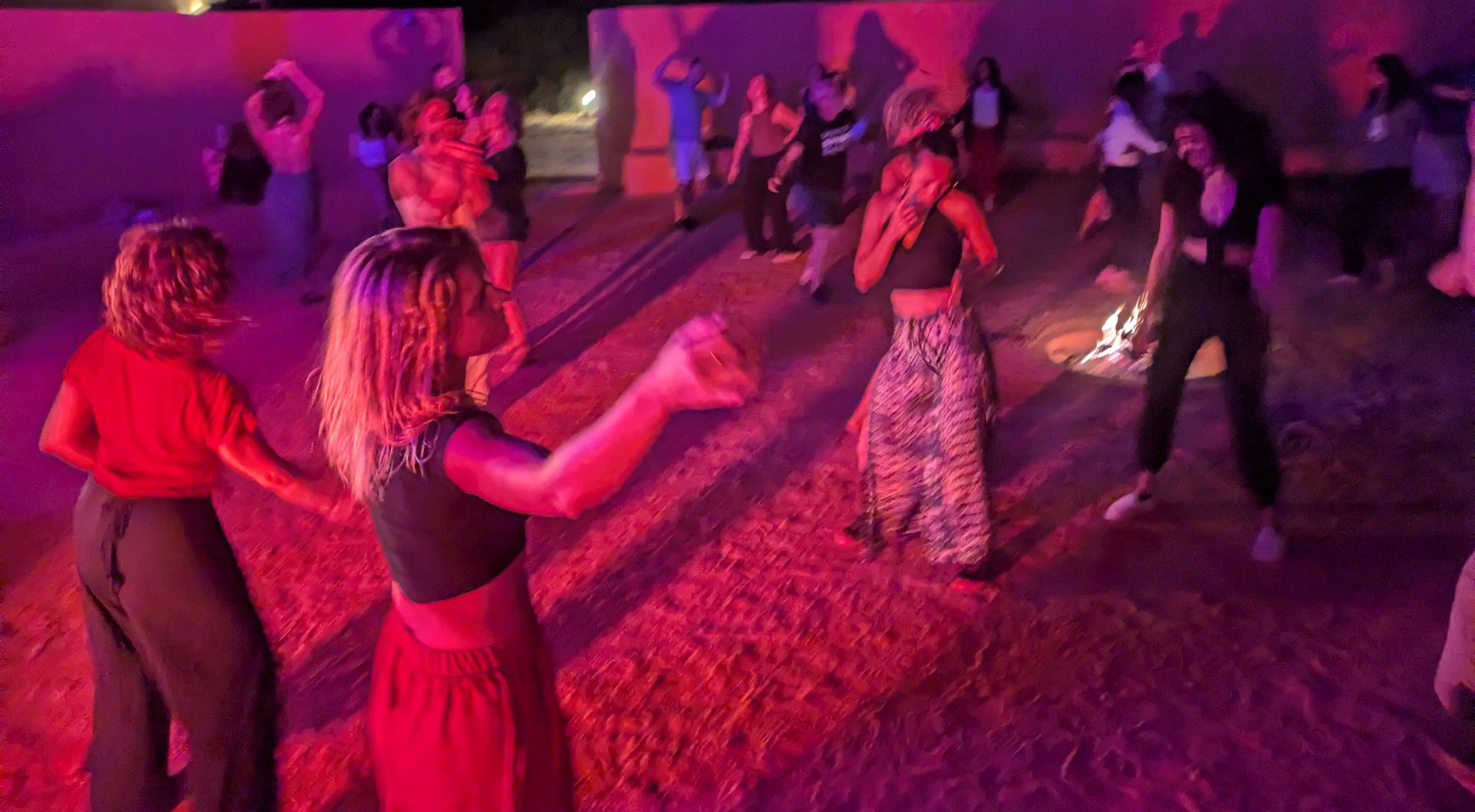
There may be no villagers left, but it is never too late to sit down by the fire, lay our bodies upon the earth, and invite our friends to do the same.
~
I don’t have many answers, and every question leads to a dozen more. I do not know how to travel from here to “there,” the village, the fantasy idea of it and the reality of it, dirt under its fingernails. The village, the only “elsewhere” still waiting for our tourist maps and curiosity.
We might never arrive. I know my freedom-loving heart chafes at every serious contemplation of a settled life. But maybe we can lay some foundations, trace a path for others to follow after us and go further than we can manage.
I can hone the tools for conflict resolution and teach my niece and nephew, and my unofficial nieces and nephews (my friends’ kids), about collaboration, empathy, and regeneration.
I can acknowledge my privileges, look my ego and my selfishness squarely in the eye, and do a little better each day, always moving towards what is life-affirming and away from extraction in my consumption, my relationships, and my work.
I can do my part to build the inner and outer conditions for “the village” even as I, as we, muddle our way to even understanding what those conditions might be.
There may be no villagers left, but they can still come back.
We can still come back.